
Key Takeaways
- Standard onboarding checklists excel at administrative tasks like documentation and account setup, but some firms still struggle to consistently connect portfolio analysis to the broader prospect and client lifecycle.
- In many firms, portfolio analysis can begin during discovery, when a prospect shares statements, and continue through onboarding as more complete account and transfer data becomes available.
- When analysis is delayed or handled inconsistently, the advisor's first substantive client conversation often has less structured insight to draw on, and downstream workflows like transition planning can start later.
- Integrating analysis into onboarding may involve clarifying workflow ownership, connecting data intake to analytical tools, and defining what output is needed at that stage of the relationship.
- Firms can address this by treating onboarding as an analytical workflow, not just an administrative one, so that structured insight is available earlier in the client relationship.
Many onboarding checklists used by advisory firms are thorough. They are detailed processes built to manage compliance documentation, account logistics, and meeting schedules. For these steps, they work well. One common workflow challenge is that the structured analysis of a prospect's or new client's existing portfolio is not always connected cleanly to those administrative steps.
Extracting, structuring, and evaluating a household's financial picture across multiple custodians and account types can begin during discovery, when a prospect shares statements, and continue through onboarding as transferred assets and custodial records become available. In some firms, however, that work is handled inconsistently or pushed later in the process. This isn't a failure of the checklist itself but a workflow pattern worth examining. The administrative process moves forward, but the analytical work may not always advance in parallel.
This article explores why portfolio analysis can fall outside the standard financial advisor client onboarding checklist, what that inconsistency can mean for advisor-client conversations and downstream workflows, and how firms can think about integrating this analytical step across discovery, proposal preparation, and onboarding.
What a Standard Financial Advisor Onboarding Checklist Covers
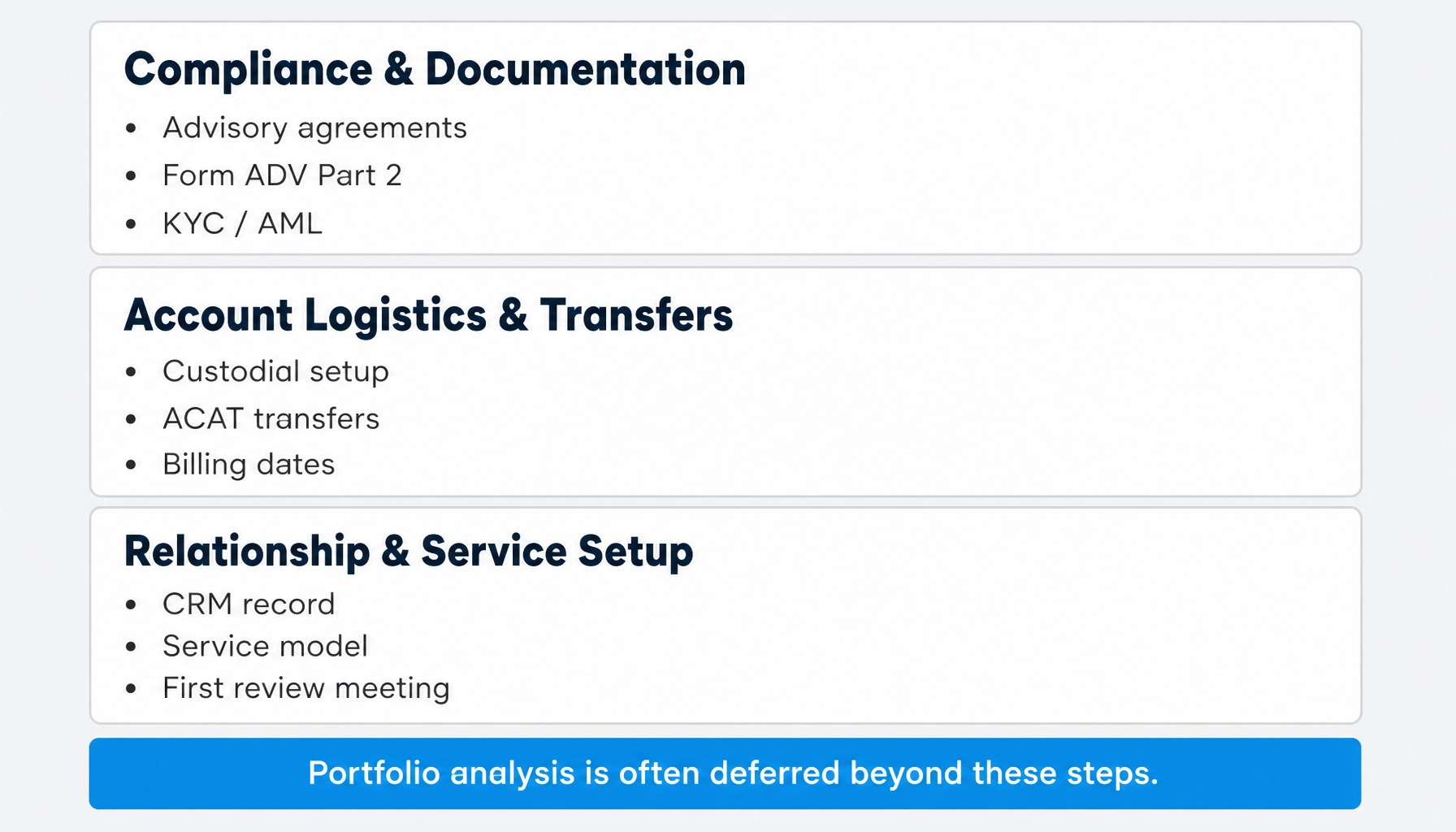
A standard wealth management onboarding checklist is designed to ensure nothing falls through the cracks from a compliance, logistical, and administrative perspective. While specifics vary, the tasks generally fall into three functional categories.
-
Compliance and Documentation: This is the foundational layer, documenting the relationship in line with the firm's own compliance framework. It typically includes executing advisory agreements, delivering Form ADV Part 2, and completing any applicable Know Your Customer (KYC), identity verification, or related documentation required by the firm, custodian, and governing regulations. It also involves reviewing and confirming beneficiary designations, Transfer on Death (TOD) registrations, and securing letters of authorization (LOAs) for account transfers. Many firms use e-signature tools to manage the execution of these materials.
-
Account Logistics and Transfers: This category covers the mechanics of moving and establishing assets. It includes custodial account setup at the firm's chosen custodian, initiating ACAT transfers, and making decisions on in-kind versus liquidate-and-transfer approaches. This stage involves significant operational detail, including cost-basis reconciliation, establishing billing inception dates, and setting up standing instructions for the new accounts. The process is often managed through a firm's CRM.
-
Relationship and Service Setup: The final category focuses on integrating the client into the firm's service model. This involves creating the client record in the CRM, documenting communication preferences, assigning the appropriate service model, and scheduling the first substantive portfolio review meeting. Many onboarding checklists treat "reviewing financials" as a single task here, but in practice, it spans at least three different activities: verifying account registrations, mapping holdings, and evaluating portfolio characteristics.
To make the financial advisor client onboarding checklist more usable in practice, firms often benefit from expressing these categories as a short operational sequence rather than a high-level framework alone.
| Stage | Representative tasks |
|---|---|
| Analytical preparation, parallel with discovery and onboarding | Gather statements or custodial data, structure holdings, and prepare a current-portfolio summary that can support discovery, suitability discussions, proposals, or onboarding reviews, depending on timing. |
| Documentation and compliance setup | Execute agreements, deliver required disclosures, collect identity and account documentation, and confirm any firm- or custodian-specific requirements. |
| Account setup and transfer coordination | Open accounts, prepare transfer paperwork, confirm registrations, and coordinate custodial logistics. |
| Relationship and service activation | Document communication preferences, assign the service model, and schedule the next substantive client meeting. |
These steps are well-understood and increasingly streamlined by technology, but they primarily address the administrative side of onboarding unless the analytical step is given a clear place in the workflow.
Why Portfolio Analysis Can Fall Outside the Onboarding Checklist
The limited treatment of deep portfolio analysis in many onboarding checklists often reflects how advisory firms are structured rather than a lack of attention to it. In some firms, the analytical step sits in an operational gap, belonging fully to neither the operations team managing the paperwork nor the advisory team leading the relationship. A common result is that administrative tasks finish on schedule while specific questions about allocation, overlap, or fees move to a follow-up conversation after the first planning meeting. The analysis still gets done, but not always within the same structured workflow.
The Handoff Gap Between Discovery and Account Setup
In many firms, the onboarding workflow has two distinct owners. The advisor or advisory team handles discovery and relationship management, while an operations team handles account opening, transfers, and documentation. Portfolio analysis, the work of extracting data from statements, structuring holdings from multiple sources, and evaluating the portfolio's current characteristics, draws on inputs from each.
This analytical work requires both the data that operations collects and the professional judgment that the advisor applies. In some cases, analysis begins during discovery, when a prospect shares statements for review. In others, it becomes more complete later, once onboarding is underway and custodial data is available. Without a defined trigger, ownership can become unclear between the initial discovery phase and the first formal review meeting.
Read more: Financial Planning Fact Finder Template: From Data Collection to Portfolio Insight
Fragmented Tools Make the Analytical Step Manual
Even when a firm wants to include portfolio analysis in its onboarding process, its RIA tech stack can work against it.
Statement data arrives as PDFs or custodial feeds. Translating that information into a structured, household-level view of holdings, asset allocation, risk exposure, fees, and tax considerations often requires manual work. An advisor or analyst may need to move between the CRM for client data, a portfolio management system for analytics, and a separate tool to create a proposal. When the analytical step requires this much manual assembly, some firms defer parts of it until later in the relationship, while others complete only a partial review during discovery and expand it during onboarding.
What Gets Deferred When Portfolio Analysis Waits
Deferring portfolio analysis doesn't stop the onboarding process. Accounts still get opened, assets are transferred, and meetings are scheduled. However, the delay can affect the quality and timing of several downstream workflows, shaping the client's initial experience and how early the advisor can share structured observations.
The First Substantive Conversation Starts Without Structured Insight
When portfolio analysis is deferred, the advisor's first substantive meeting with a new client often centers on a general review of account statements rather than a structured, data-informed dialogue. The conversation becomes more qualitative and less analytical, making it harder to communicate specific observations about diversification, fee structures, risk exposures, or concentrated positions .
In a hypothetical case, an advisor meets a new client who has just completed the transfer of a $2M portfolio from a previous firm. The advisor has the statements but has not yet had the chance to structure the data into a current-vs.-proposed comparison. The advisor can discuss goals and risk tolerance but cannot yet show the client, with objective data, how their current allocation maps to those goals or how a proposed strategy might differ. The chance to ground that first conversation in structured portfolio data is postponed.
Transition Planning and Proposal Workflows Start Late
Portfolio transition planning, the work of evaluating a client's current holdings in relation to a proposed allocation, relies heavily on structured portfolio data. It also depends on custodial records, tax considerations, client objectives, and the firm's operational processes.
When this data isn't extracted and organized during the onboarding phase, much of the transition analysis and proposal creation workflow waits until the advisor or an investment team member manually assembles it. That wait can extend the time between the client committing to the firm and receiving a clear, personalized recommendation with a documented transition plan. Practical steps like cost-basis reconciliation and decisions around in-kind transfers typically draw on structured portfolio data alongside custodial information and client-specific considerations.
Integrating Portfolio Analysis into the Onboarding Sequence
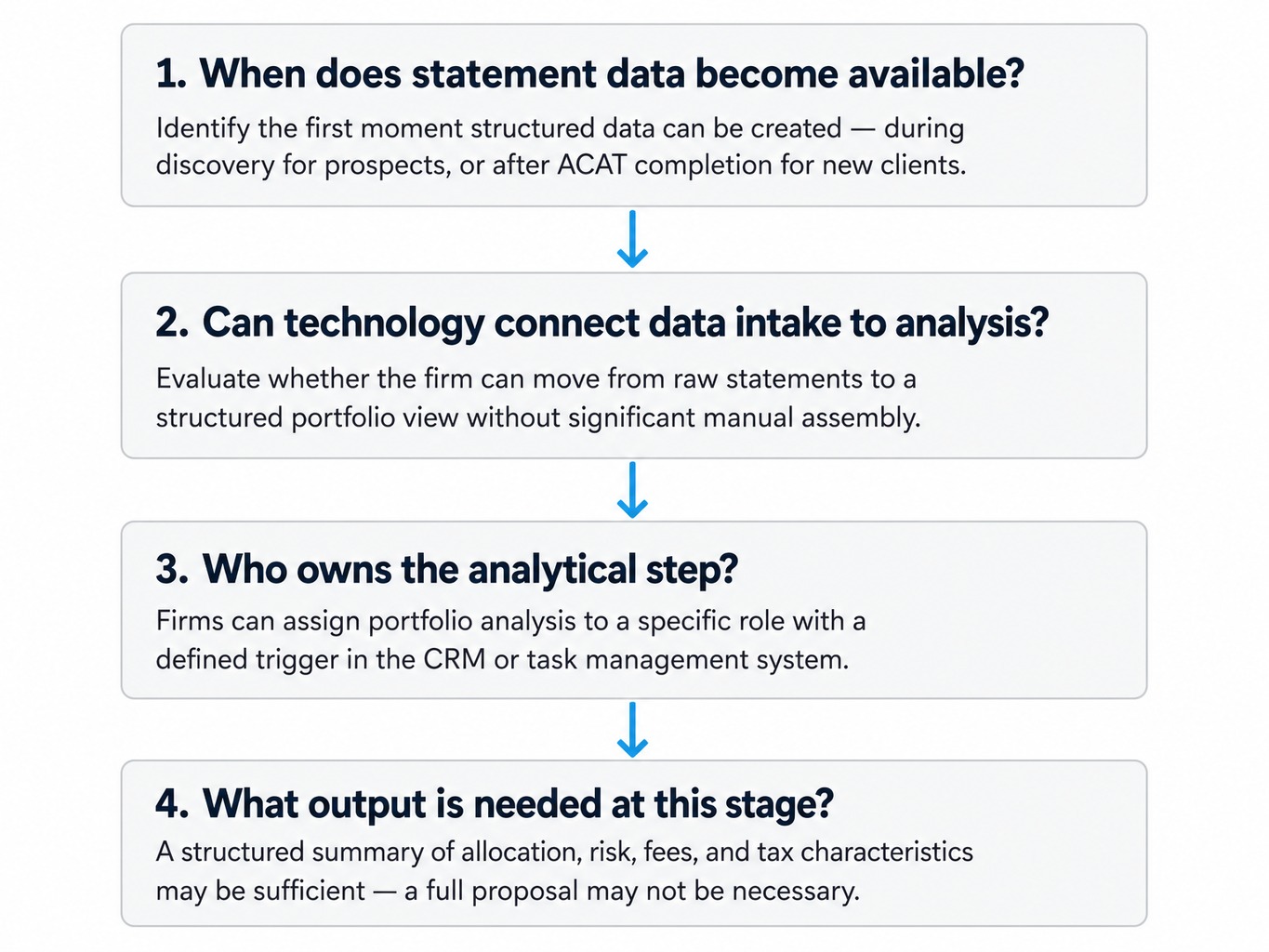
There is no single correct way to integrate portfolio analysis into onboarding, as the ideal sequence depends on a firm's size, team structure, and custodial relationships. Portfolio analysis can support discovery, suitability considerations, and client objectives at different points in the lifecycle, rather than following one universal order. However, firms can evaluate their own workflows by asking a few key questions.
First, where in the timeline does statement data become available? For prospects, statements are often provided during discovery. For new clients, more complete data on transferred-in assets may only be available after the ACAT process completes. Pinpointing the first moment structured data can be created is the starting point.
Second, can the firm's technology connect data intake to analysis without significant manual work? The fewer handoffs required to move from a raw statement to a structured portfolio view, the more practical it becomes to make analysis a standard onboarding step.
Third, who owns the analytical step? If portfolio analysis is assigned to a specific role, be it an advisor, an investment team analyst, or an operations professional, with a defined trigger in the firm's CRM or task management system, it is less likely to be deferred.
Finally, what output is needed at this stage? A full, multi-page proposal may not be necessary. A structured summary of the current portfolio with key observations on allocation, risk, fees, and tax characteristics can provide a useful foundation for the first substantive client conversation.
Read more: Automation in Wealth Management: Why Half-Automated Workflows Can Create More Risk Than Manual Ones
How VRGL Connects Data Intake to Portfolio Analysis Within the Onboarding Workflow
One common tension in advisory workflows is the gap between collecting client or prospect documents and producing structured, usable portfolio insight. That gap can appear during discovery, when a prospect shares statements for evaluation, and it can continue into onboarding as more complete account and custodial data becomes available.
VRGL is designed to support the prospect-to-proposal workflow that begins once statements have been collected, while also helping firms carry that analytical work forward into client onboarding. Discovery and fact-finding remain with the advisor and the firm's existing process. From there, VRGL helps teams extract holdings from statements with AI-powered statement extraction, organize the data into a structured portfolio view, and evaluate the current portfolio through comparative analytics.
That makes it easier for advisors to move from raw statements to client-ready outputs, including current-versus-proposed comparisons and proposal materials that can support discovery conversations, suitability discussions, and client objective reviews. When a prospect becomes a client, the same analytical foundation can also inform the transition into onboarding without conflating acquisition with account-opening or custody workflows.
For enterprise firms, this can contribute to a more consistent approach to analytical preparation across advisors and offices, supporting the work behind advice without replacing advisor judgment.
See how VRGL connects statement extraction, portfolio analytics, and client-ready proposals. Request a demo .
Conclusion
An onboarding checklist that focuses only on compliance, logistics, and relationship setup may leave an important step outside the onboarding window. By deferring portfolio analysis, firms postpone the opportunity to deliver data-informed insights and delay downstream workflows like transition planning.
This deferral often reflects structural factors such as workflow ownership gaps and fragmented technology. It is, however, addressable. By evaluating how and when data intake connects to analysis and presentation, firms can begin to treat onboarding as an analytical workflow, not just an administrative one. For firms whose clients value transparency and speed, building structured analysis into the beginning of the relationship can help bring data-informed insight into client conversations earlier.
Frequently Asked Questions
What documents are typically needed to onboard a new financial advisory client?
Common documents include signed advisory agreements, applicable identity verification and compliance documentation, letters of authorization for account transfers, recent investment account statements, insurance policies, estate planning documents (trusts, wills, powers of attorney), tax returns, and beneficiary designation forms. The specific requirements can vary based on the firm's compliance framework, custodial relationships, and the complexity of the client's financial situation.
How do in-kind transfers and liquidate-and-transfer approaches differ during onboarding?
From a workflow perspective, the difference lies in what moves between custodians: an in-kind transfer moves existing holdings, while a liquidate-and-transfer approach moves cash. The choice is a client-specific decision that firms typically review with the client and the client's tax professional. It often depends on the transferability of specific holdings, the client's broader circumstances, and the firm's transition planning process.
How can multi-advisor firms maintain consistency in their onboarding workflow?
Firms with multiple advisors or offices may consider establishing governed onboarding templates, standardized task sequences within their CRM or workflow management system, and defined checkpoints for compliance review. The goal is typically to create a shared baseline for documentation, data collection, and analytical preparation while allowing advisors flexibility in how they conduct discovery conversations and build client relationships.
What onboarding considerations apply to complex household or UHNW clients?
Complex households may involve multiple account registrations (individual, joint, trust, entity, retirement), held-away assets across several custodians, and estate planning structures that affect how portfolio data is aggregated. Onboarding these clients often requires coordination across custodians, additional documentation for entity accounts, and a more detailed initial portfolio review to capture a complete household-level view and understand any concentrated positions.
When in the onboarding process is the investment policy statement typically documented?
Practices vary, but many firms document the investment policy statement (IPS) after the initial discovery meeting and portfolio review, once the advisor has gathered enough information about the client's goals, risk tolerance, and constraints. Some firms treat the IPS as a living document that is drafted during onboarding and refined after the first substantive portfolio conversation has taken place.
This content is for informational purposes only and should not be considered investment, legal, tax, or compliance advice. VRGL does not provide investment, legal, tax, or compliance advice and does not assume any fiduciary responsibility for its users. Firms may wish to consult their own legal and compliance professionals regarding whether their practices and procedures comply with applicable laws and regulations.